Business owners — Overview
Current source defines Business Owners as an authenticated level-2 user inventory with profile, address, orders, business assignment, metadata, account-state, export, creation, and deletion surfaces. This guide documents fixed-source behavior only; no owner, business, order, or relationship data was accessed.
Mounting the list reads PII. Opening tabs can read additional private user, order, address, business, and metadata records. Enable, profile, assignment, Custom fields, add, export, and delete controls can persist or disclose data. GET and HEAD are not presumed safe.
Availability and automatic reads
The /users/business-owners route and Users sidebar parent require level-0 administrator access; the parent also excludes read-only state. The shared list requests active level-2 accounts on mount and repeats the request for active state, search, advanced filters, and pagination. API authorization remains independent of route and menu visibility.
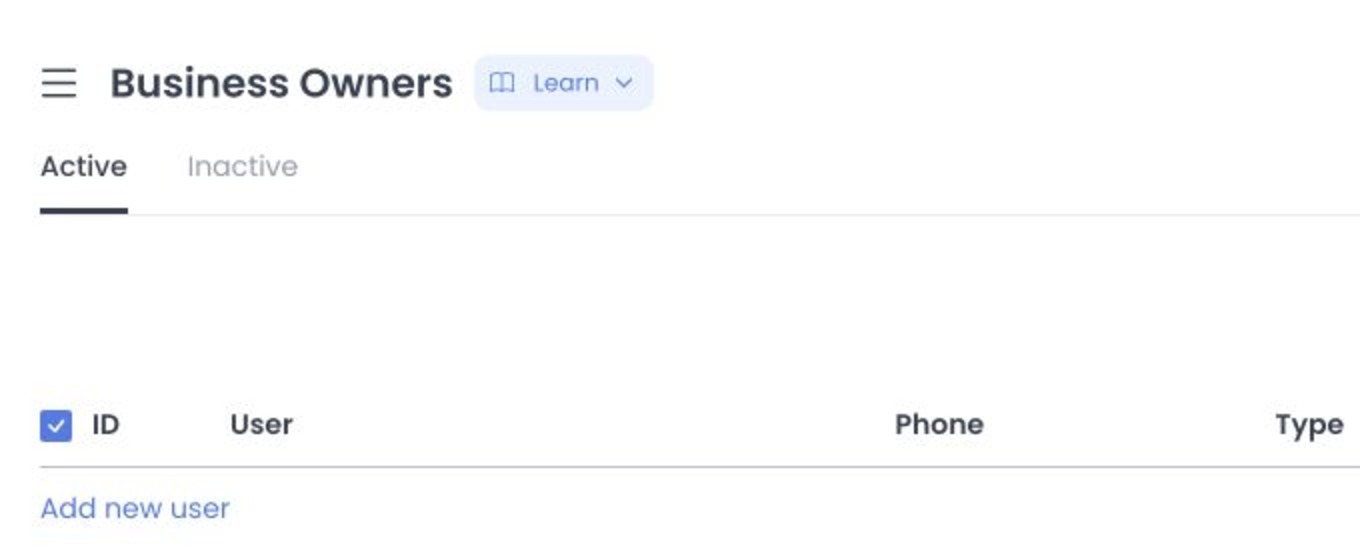
Private list and detail surfaces
Source-defined search spans name, last name, email, and cellphone. The rendered shared filter for this page contains name, email, last name, order-count condition/value, country phone code, cellphone, phone/email verification, user type, loyalty level, and sign-up date. Active/Inactive is a separate state control; Customer-only ID/external-ID fields are not Business Owner filter controls. Returned records can contain profile, address, wallet, push-token, order-count, and other personal or operational data.
Selecting a row can reuse list data; a direct-ID detail can issue an additional user read. Profile, Saved places, Orders, Businesses, and Custom fields can trigger additional authenticated reads. No query, record, tab, field, or relationship was opened.
Account and metadata writes
The row/detail Enable switch immediately submits an account update. Profile save can change identity or contact fields, image, password, or role subject to API rules. Custom fields reads metadata on open and exposes create/delete requests. Confirmed Delete mutates identifiers, deletes the record, writes an audit log, and can invoke plugin actions. Add, export, and bulk-delete controls create, disclose, queue, or remove private data.
Business-assignment reads and replacement semantics
Opening Businesses performs separate reads for the owner's current relationships and a paginated backoffice business inventory. Search can query business names. The selection is local until the update action submits the complete businesses array through the user-update path.
Current API source restricts business relationship replacement to administrators. It compares the submitted unique business IDs with current owner relationships, deletes removed links, and inserts added links. These are source contracts, not proof of hosted atomicity or authorization.
The inspected client source builds Select all from only the currently returned business page and replaces the local selected-ID array. Saving that array can therefore remove relationships that were selected on another page or were not returned. Do not use Select all/none or save an assignment without a corrected client and an isolated synthetic fixture.
Creating a Business owner does not itself submit a business assignment in this source flow. Assignment is a separate persistent action.
Privacy classification
Names, emails, phones, addresses, birth dates, locations, verification state, images, passwords, wallets, push tokens, orders, business identities, relationship sets, and user metadata are private, personal, credential, or secret-adjacent data. Do not copy live values into screenshots, tickets, logs, chat, or documentation.
What remains unverified
Without immutable Dashboard/API serving receipts and an approved PII-free synthetic owner/business fixture with exports, sessions, uploads, metadata, orders, plugins, and all writes intercepted, this page does not claim deployed reachability, result completeness, successful update/delete, assignment atomicity, off-page preservation, or safe retry.