Plugin settings
The fixed Dashboard source requests the key_plugin parent category for Plugin settings and builds its child navigation from the categories returned for the current project. The Plugin settings panel is available only when that returned child list is non-empty. Numeric category IDs and child inventories are therefore project-specific runtime data and are not portable between projects.
Historical navigation media
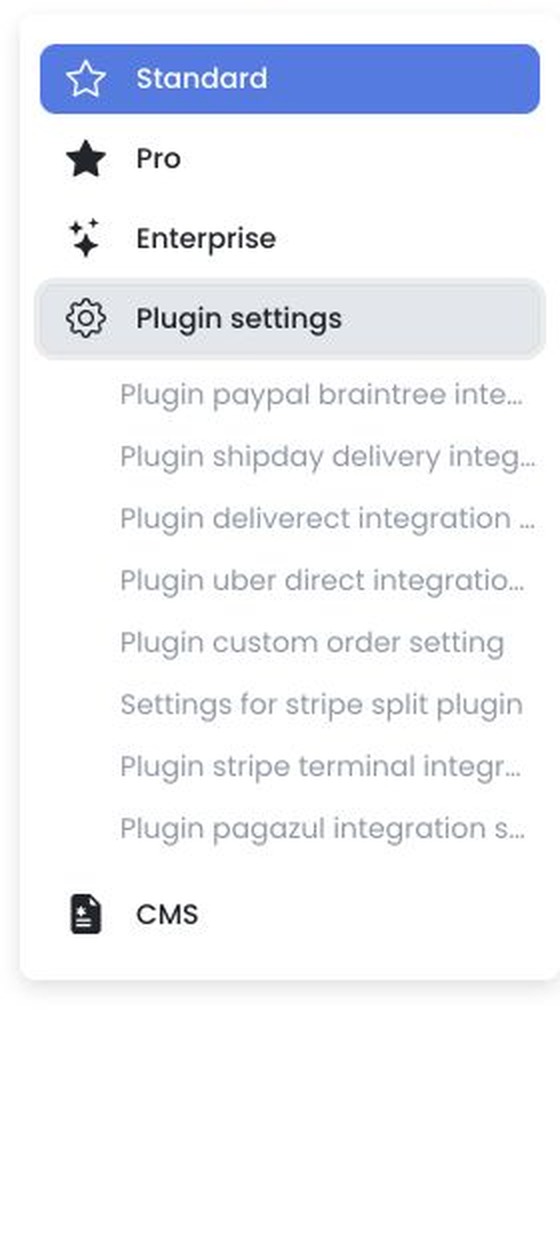
The retained predecessor material listed PayPal Braintree, Shipday, Deliverect, Uber Direct, Custom Order, Stripe Split, Stripe Terminal, and Pagazul. That eight-item list is historical fixture evidence only. The fixed API catalogue contains the key_plugin parent, but it does not contain authoritative child configuration schemas for those eight names.
Settings and management are separate surfaces
Returned Plugin settings categories use the shared settings interface. Fixed source shows that ordinary fields are staged and then updated sequentially, while an image field can update immediately. The exact labels, field types, validation, defaults, secrets, provider calls, and plugin-specific effects can still be supplied dynamically by the project or plugin and remain runtime-dependent.
The legacy control DASH-LEG-010 at the direct /settings/plugin route is the terminal audit-only reference to the separate Developers plugin-management surface, not a second public Plugin settings page. Its source includes actions that can add a plugin URL, install a system plugin, enable or disable a plugin, refresh metadata, or delete a plugin. Refreshing can retrieve external plugin metadata, and a plugin's own General settings can be hosted outside the core Dashboard.
Plugin URLs, endpoints, credentials, account identifiers, webhooks, order or customer data, provider responses, and external configuration must not be captured. Installation, enablement, refresh, deletion, connection, or provider testing is not a documentation-discovery method.
Evidence boundary
The existing screenshot is retained as historical navigation media. Re-entry for DASH-LEG-010 requires one approved synthetic fixture that proves the direct route without invoking an action. Any Plugin settings fixture must establish the exact returned category, visible labels, required state, defaults, validation, save scope, and external effects while keeping every value synthetic and excluding provider traffic.
Until immutable deployment and runtime receipts exist, the fixed sources establish only the dynamic category mechanism and the separate operational management surface—not an installed plugin inventory or a working integration.
Related guides: Developers · Settings overview