Enterprise delivery features
Current API source catalogs 40 delivery fields across five nested groups: 6 for order/status management, 7 for driver assignment/scheduling, 24 for driver permissions/controls, 1 for offline functionality, and 2 for auto-assignment penalties. A project response determines what Dashboard renders; no delivery category or value was requested.
Every authenticated read and write remains blocked. Catalog labels describe effect classes only; they do not prove assignment, schedule, driver, location, status, offline, penalty, customer, or business behavior.
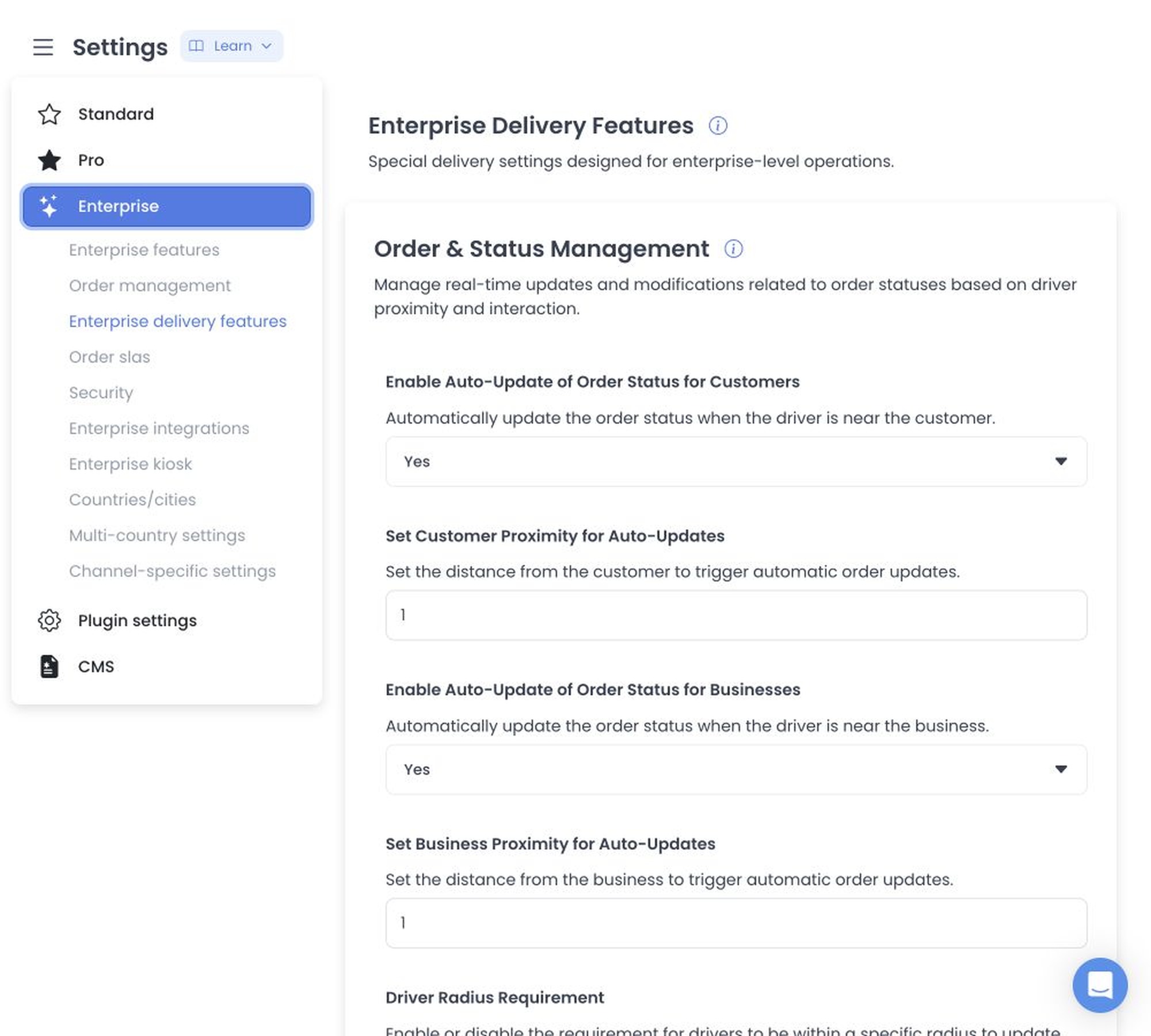
Order & Status Management
Source catalog associates this group with customer/business status-update and driver-radius fields. It does not prove configured values, proximity calculations, notifications, or status transitions.
Driver Assignment & Schedule
Source catalog describes reassignment, administrator assignment, scheduled login, availability strategy, manager schedule updates, and schedule/block selection. No user, schedule, assignment, or availability state was read.
Driver Permissions & Controls
Source catalog includes order rejection, profile and availability permissions, ETA, pickup/status, delivery-time, mock-location, image, location-validation, and priority fields. These names do not authorize a driver/order/location probe.
Catalog labels use meters for minimum distance and minutes for validity for status codes 3, 9, 11, and 26. Fixed source does not establish the deployed meaning, value, calculation, evidence, or successful transition for any code.
Offline changes and assignment penalties
Catalog groups include an offline-change field plus missed-assignment and penalty-duration fields; the duration label uses minutes. No offline queue, assignment, penalty, job, event, websocket, or notification was inspected.
Source-defined write boundary
The shared editor stages ordinary fields until Save and writes configs sequentially, so later failure can follow earlier persistence. Runtime re-entry requires synthetic orders, drivers, schedules, locations, businesses and customers; intercepted reads/writes/events; and immutable receipts for every effect.
Related guides: Delivery overview · Manage delivery · Add-ons overview