Channel-specific settings
The fixed Dashboard source defines Channel-specific settings as the Enterprise option sites, routed through /all-settings?category=sites. The Enterprise settings panel requires Enterprise eligibility and a returned Enterprise category list.
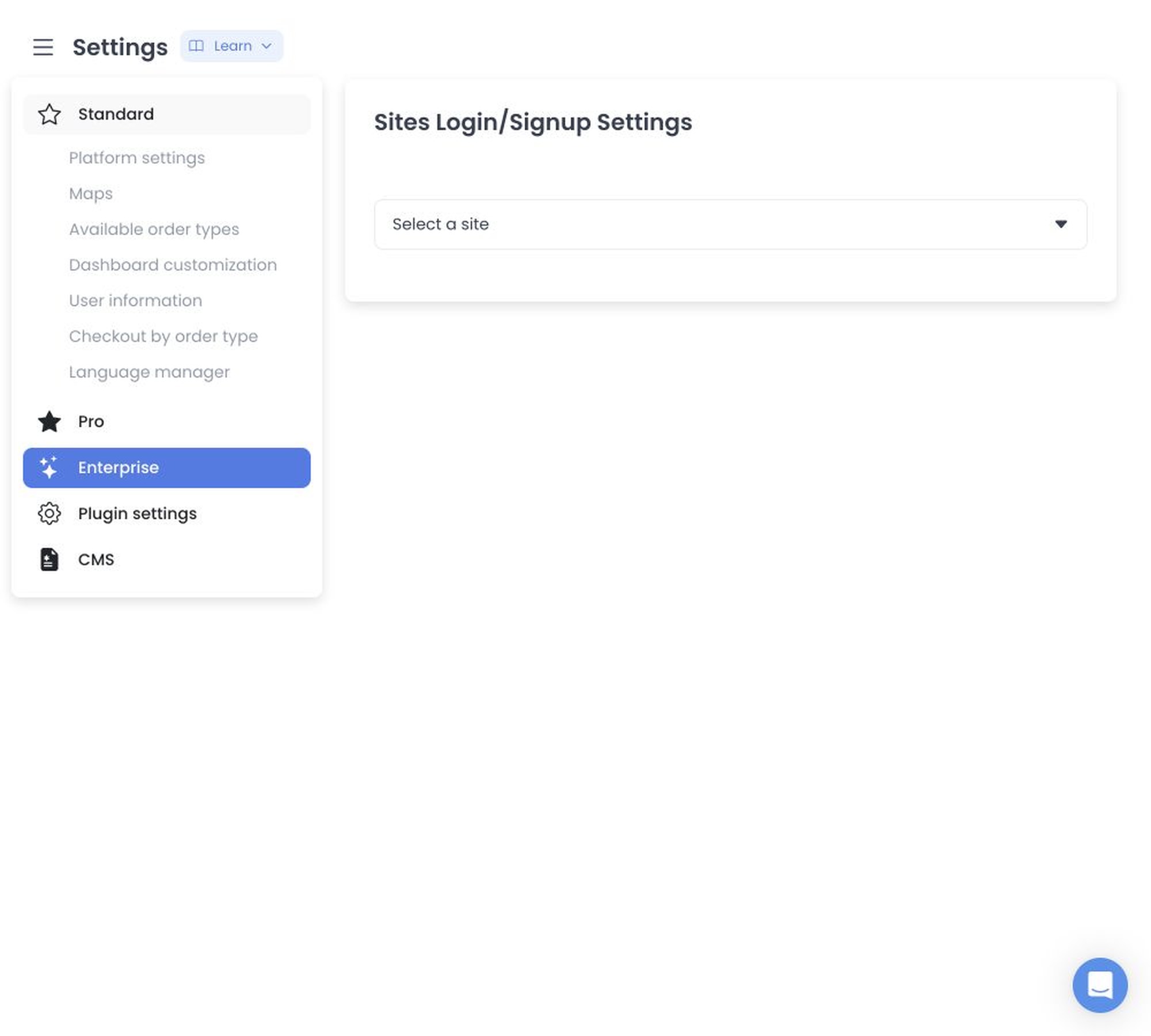
On mount, the Enterprise view requests the available site or channel records without the non-Enterprise product-code filter. Selecting a site—or opening a deep link that identifies one—requests configurations that the API marks as replaceable by site. The client groups returned records by their configuration category and renders source-supported text, select, and password controls.
Returned configurations can include credentials, URLs, identifiers, sign-in controls, analytics, messaging, maps, or other integration settings. Values and provider details must not be copied into documentation, screenshots, tickets, or chat.
Source-defined override contract
Text, select, and password changes send an immediate update for the selected site and configuration; there is no page-level Save step. The API requires a non-empty value of 1–2,000 characters, an existing site, and a configuration marked as replaceable by site. If no site override exists, the update path creates one, and extension hooks can alter or react to the result.
Protected configurations are returned with the placeholder PROTECT. For non-administrators, reads are limited to public, non-hidden configurations. The placeholder is a display safeguard, not evidence that a credential is valid or safe to replace.
The retained predecessor material listed Marketplace Website, Kiosk, Call Center, App Marketplace, Dashboard, Franchise website, and several integration groups. That list is historical fixture evidence only. The fixed source establishes a dynamic returned site list and category grouping, not those exact channels, groups, fields, or their deployed configuration.
Evidence and capture boundary
Safe evidence is limited to an approved synthetic selector with no site selected and no configuration groups or values displayed. Credentials, endpoints, account identifiers, customer data, provider responses, and production configuration remain excluded.
The fixed source establishes route eligibility, authenticated reads, grouping, validation, protected-value handling, and immediate-write behavior. Deployed availability, returned schema, persistence, integration success, and downstream effects require separate immutable receipts.
Historical media
Related guides: Enterprise settings · Kiosk settings