My products
My products is the Dashboard area for installed product settings and app-specific configuration. In the current implementation, the base /my-products URL is not a reliable overview of all installed products.
The base /my-products URL requires a product ID. Without one, the current page returns to Home. A project-specific URL such as /my-products?id=… loads the matching builder app, but that numeric ID is local to the project and must never be copied between projects. Use the sidebar instead of treating the base URL as a product inventory.
Navigate to an enabled product
Use the My products and addons sidebar section and select the installed product you need. Which entries appear depends on current project configuration and installed app data.
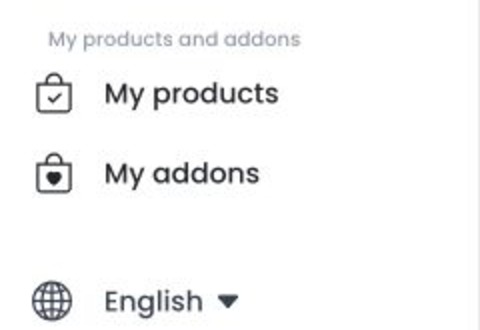
Current source defines these destination classes:
- Ordering website — the legacy website item while
web_franchises_xis not enabled. - Ordering website 2 — a separate item only while
web_marketplace_26is enabled. This conditional pointer does not replace or redirect the retained legacy route. - Dashboard — only while
web_dashboard_xis enabled. - Franchises website — only while
web_franchises_xis enabled in the sidebar. The route has broader loading and franchise-site mount conditions that do not make the item visible. - Builder-app entries — project-specific items that use a product ID as context.
These are destinations, not a universal list of products or a guarantee that each product is installed, configured, purchasable, or ready to publish.
Work safely in product settings
Product-specific pages can include configuration, domain/business data, themes, app builds, downloadable artifacts, QR codes, credentials/certificates, logs, and external setup links. Some website and Dashboard product controllers can also create or normalize a site/theme record during initial loading. They are not passive review surfaces and are not covered by this overview.
- Open only the product that you are authorized to manage.
- Do not use production product settings for experimentation.
- Do not share app IDs, domains, business data, download links, QR codes, build output, credentials, certificates, tokens, or external setup URLs.
- Follow the dedicated guide and release process for a specific product before saving, building, downloading, or connecting anything.
Installed and available are different states
The sidebar uses enabled configuration and project app data to decide which destinations to show. Billing/catalog availability is managed separately in Apps & Addons catalog. A visible product destination does not reveal its price or subscription status, and an available catalog add-on does not by itself create a working product configuration.
Troubleshooting
Why does /my-products return to Home?
The product page needs an id query parameter. Open an enabled product destination from the sidebar so the Dashboard supplies the correct project-specific context.
Why is a product missing from the sidebar?
Its configuration/app state may not meet the corresponding visibility condition. Confirm the project’s enabled product state with an administrator; do not try to infer installation from the base overview.
Can I use the base page to buy or enable a product?
No. Purchasing is a separate Billing workflow, and product-specific setup can involve sensitive credentials, builds, domains, and external actions.
What is the unlinked /ordering-products route?
Current source retains this level-0 route, but its sidebar button is commented out. The page can read sites and product records and exposes persistent Add and Edit workflows. It remains an audit-only legacy boundary: this overview does not link to it, document it as a supported workflow, or create a replacement page. Re-entry requires product-owner confirmation and a synthetic builder fixture with every read and write intercepted.
Related guides: Apps & Addons catalog · Platform settings