Cart recovery rules
Cart recovery rules is a level-0 source route for write-capable automation records. Opening it starts authenticated rule reads, and any enabled rule/channel can participate in outbound effects; do not use it as a documentation probe.
The route and its enabled Marketing item are level 0. Effective sidebar reachability separately requires Pro or Enterprise and excludes read-only administrator, delivery-manager, and business-owner classifications. No additional cart-recovery plan or configuration gate was found in the reviewed route/item source. Open carts is a separate route.
Re-entry requirements
- Use synthetic rules, channels, carts, recipients, consent state, and content.
- Deny all outbound transports, callbacks, jobs, and event dispatch.
- Intercept rule and channel writes and prove production queues are unreachable.
- Admit runtime only with immutable receipts for every read, write, and blocked outbound effect.
Dashboard source writes rule and channel records. API source can dispatch channel work from an internal event path. No rule, channel, event, audience, cart, recipient, provider, job, or send was accessed or triggered.
Source-defined form
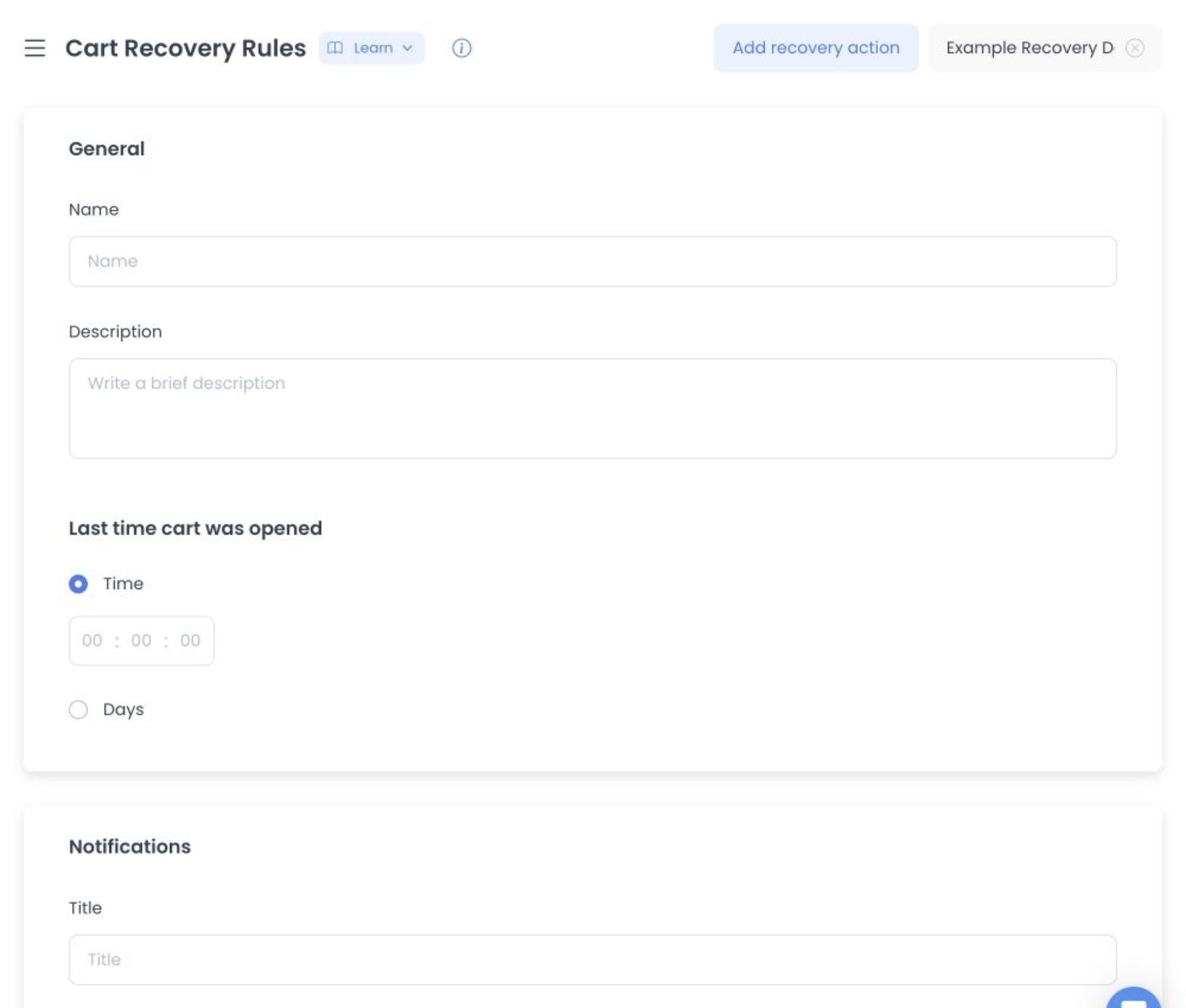
Current source lists and searches event-rule records. The add panel models an abandoned-cart rule. General state includes name, description, enabled state, and a time-based condition. Channel state includes a type and content fields. These values can contain sensitive marketing or personal data. No field was opened, populated, or submitted.
The reviewed client constructs a time-based rule and then a channel request. API source supports additional launch and channel contracts, but this article does not expose them as runnable Dashboard capabilities or promise timing.
Write, partial-completion, and outbound boundaries
Rule enablement updates immediately from the list. The detail flow defines rule register/update/delete and channel register/update/delete requests.
For creation, client source submits the rule before it submits the channel. A channel failure can therefore follow an already-created rule; do not assume atomic rollback or unchanged automation state.
API source contains an internal event-dispatch path that can load cart and customer state and enqueue channel-specific work after eligibility checks. This source trace is not evidence of deployed scheduling, delivery, consent, provider success, or exact timing.
Runtime remains blocked until a synthetic fixture proves deny-all outbound transport, callback, job, and event dispatch while capturing immutable partial-write receipts.
Related guides: Ad banners overview · Create or edit an ad banner · Open carts overview